
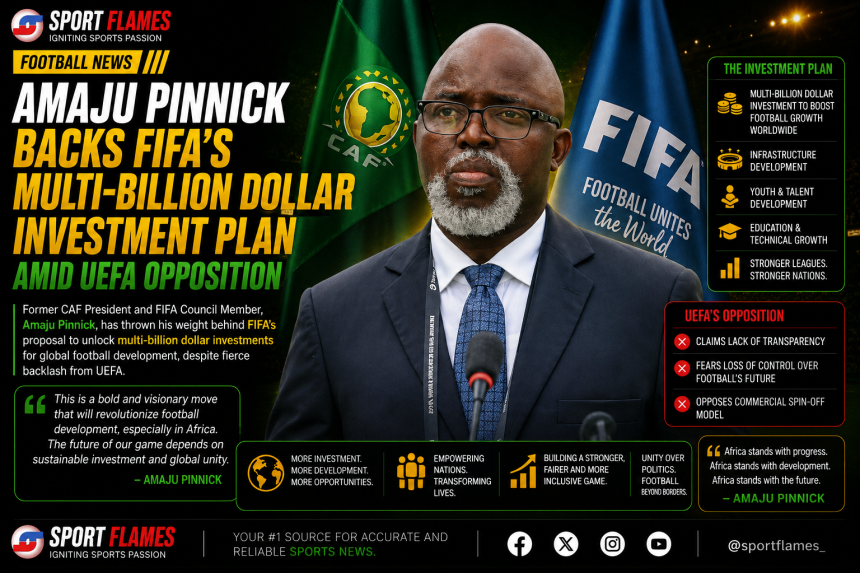


Former Nigeria Football Federation (NFF) president Amaju Pinnick has thrown his support behind FIFA’s controversial proposal to create a new commercial subsidiary aimed at boosting funding for football development, insisting the initiative is about empowering member associations rather than “selling the soul of the game.
The proposal, unveiled by FIFA in late July 2026, has sparked one of the biggest governance debates in world football, drawing fierce opposition from UEFA while receiving backing from officials representing many developing football nations.
FIFA’s $20 Billion Vision
At the heart of the proposal is the creation of the FIFA Forward Enterprise (FFE), a commercial subsidiary valued at approximately $20 billion. The new entity would oversee the business operations of FIFA’s flagship competitions, including the men’s and women’s FIFA World Cups and the FIFA Club World Cup.
The subsidiary would manage commercial assets such as broadcast rights, sponsorships, ticket sales, licensing and tournament delivery, while FIFA would retain majority ownership and full control over football governance, sporting regulations and competition management.
Under the proposal, FIFA intends to sell up to a 20 percent minority stake in the company to private investors, with reports suggesting the move could generate as much as $4.2 billion in fresh capital.
FIFA President Gianni Infantino has described the initiative as an opportunity to generate significantly more revenue for football development worldwide, stressing that no aspect of the sport’s governance or competitions would be handed over to private investors.
Pinnick: “The Beneficiaries Are the Member Associations”
Speaking during an interview on Arise Television, Pinnick defended the proposal, arguing that the discussion should focus on how increased funding could transform football across Africa and other developing regions.
According to the former FIFA Council member, the real shareholders of FIFA are its 211 member associations, making them the primary beneficiaries of the proposed investment.
“The shareholders are the member football associations Nigeria, Niger, Ghana, South Africa and others. These are the main beneficiaries,” Pinnick said.
He noted that FIFA’s existing Forward Programme, combined with the proposed Fast-Forward initiative, could provide each national association with funding of up to $40 million during the 2027–2030 cycle.
If, for example, you have $40 million, trust me, you don’t need government to run football,” Pinnick added, emphasising that transparency and proper management of the funds should be the key concerns rather than opposition to private investment itself.
Pinnick also expressed confidence in Infantino’s leadership, arguing that the FIFA president has consistently increased financial support for national federations since taking office.
UEFA Rejects Proposal
The proposal has, however, met strong resistance from UEFA, which represents Europe’s 55 national football associations.
European football’s governing body argues that football’s biggest competitions should never become commercial investment assets, warning that the World Cup is part of the sport’s heritage and not a commodity to be traded.
UEFA has also criticised FIFA over what it describes as a lack of transparency and consultation, with reports indicating European associations have unanimously opposed the proposal and warned they could reconsider participation in FIFA competitions if the plan proceeds without significant changes.

The disagreement has highlighted growing tensions between FIFA’s ambition to expand football’s commercial value globally and UEFA’s desire to protect the traditional governance of the sport.
What’s at Stake?
For many developing football nations, the proposal represents a rare opportunity to secure stable, long-term funding for infrastructure, youth development, coaching programmes and domestic competitions.
Supporters argue that increased financial independence could reduce reliance on government funding and strengthen football administration across Africa, Asia and other emerging football regions.
Critics, however, fear that introducing private investors into the commercial structure of FIFA’s flagship tournaments could set a precedent for greater commercialisation and potentially undermine the long-term independence of world football.
FIFA has insisted that “nobody is selling football”, maintaining that the governing body will continue to control all sporting decisions while simply maximising commercial revenue for redistribution to member associations.
The proposal will now undergo a consultation process before being put to FIFA’s 211 member associations, with a final decision expected later in 2026.
As discussions continue, the debate has become one of the defining governance issues in global football, pitting financial expansion against concerns over tradition, ownership and the future direction of the world’s most popular sport.