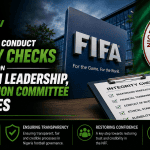

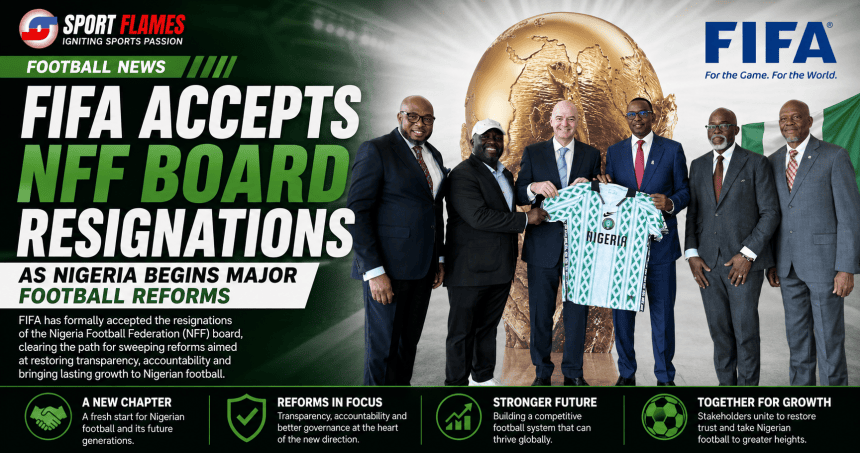


FIFA has formally accepted the mass resignations of the Nigeria Football Federation (NFF) executive committee led by former president Ibrahim Musa Gusau, paving the way for a major restructuring of football administration in Nigeria.
The development followed a high-level meeting on September 1, 2026, between Nigerian football officials and FIFA President Gianni Infantino at the Home of FIFA in Zurich, Switzerland.
The meeting focused on governance reforms, institutional restructuring and a roadmap aimed at creating a more stable and effective football administration in Nigeria.
The Nigerian delegation was led by National Sports Commission (NSC) Chairman Shehu Dikko and included NSC Director-General Bukola Olopade, NFF Acting General Secretary Dr Emmanuel Ikpeme, NFF Director of Legal Services Okey Obi and former NFF president Amaju Pinnick. Representatives of the Confederation of African Football (CAF) also participated in the discussions.
Pinnick’s presence attracted considerable attention in Nigerian football circles, particularly amid speculation that he could play a leading role in the transition.
However, Dikko clarified that Pinnick attended in his official capacity as an adviser to the CAF President and as a vice-president of FIFA’s men’s competition organising committee.
According to Dikko, FIFA insisted on Pinnick’s presence because of his senior positions within the international football structure, while stressing that he remained the leader of the Nigerian delegation.
FIFA subsequently confirmed its acceptance of the resignations of Gusau, NFF General Secretary Mohammed Sanusi and the other members of the executive committee.

The mass resignations came amid growing pressure on the federation following Nigeria’s failure to qualify for the 2026 FIFA World Cup and the Super Falcons’ failure to secure qualification for the 2027 Women’s World Cup.
Infantino described the Zurich discussions as successful and stressed the importance of strengthening Nigeria’s football structures while creating clearer pathways for young talents.
Both sides agreed to continue refining a comprehensive reform roadmap covering short-, medium- and long-term objectives. The ultimate goal is to establish an inclusive and stable NFF capable of delivering improved results both on and off the pitch.
As part of the transition, a normalisation committee is expected to oversee Nigerian football for approximately three months while reforms are implemented and preparations are made for fresh NFF elections.
Reports linking Pinnick with the leadership of the proposed normalisation committee have, however, been dismissed. A senior sports official said Pinnick made it clear during the Zurich meeting that he intends to concentrate on his private business interests and existing responsibilities within international football.
Meanwhile, the NFF has rejected reports of a FIFA letter threatening sanctions against Nigeria, describing the circulating document as “totally fake”.
The federation said engagement between the NSC, the interim NFF administration, CAF and FIFA remains ongoing in accordance with the relevant statutes.
The Zurich meeting represents a significant step towards resolving the governance crisis that has engulfed Nigerian football and could mark the beginning of a new era of administrative reforms in the country’s football system.