

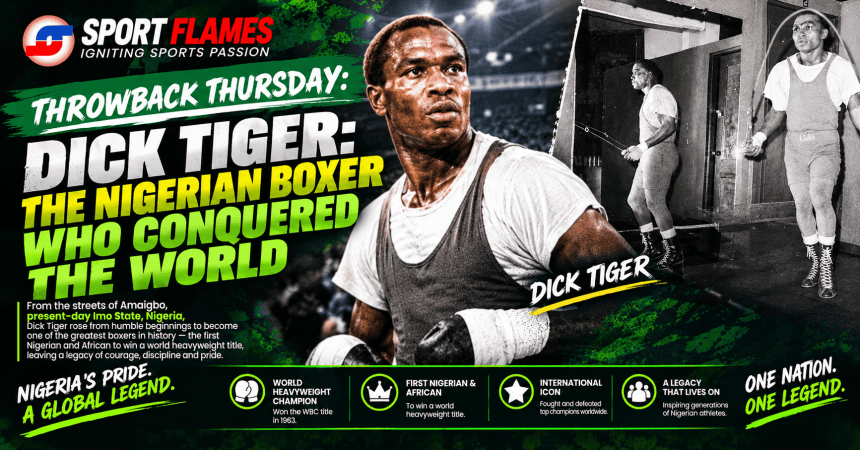


Long before Nigerian athletes became familiar names on the biggest sporting stages around the world, one man from eastern Nigeria had already climbed to the top of professional boxing.
His name was Richard Ihetu, but the world knew him as Dick Tiger.
Born on August 14, 1929, in Amaigbo, present-day Imo State, Tiger grew up in an era when professional boxing was still developing in Nigeria. Through determination, strength and an unrelenting fighting spirit, he would eventually become one of the most respected boxers of his generation.
Tiger began his professional career in Nigeria before travelling to Britain, where he continued to develop his reputation against increasingly difficult opposition.
One of his early encounters in Britain produced a moment that would perfectly capture the kind of fighter he was.
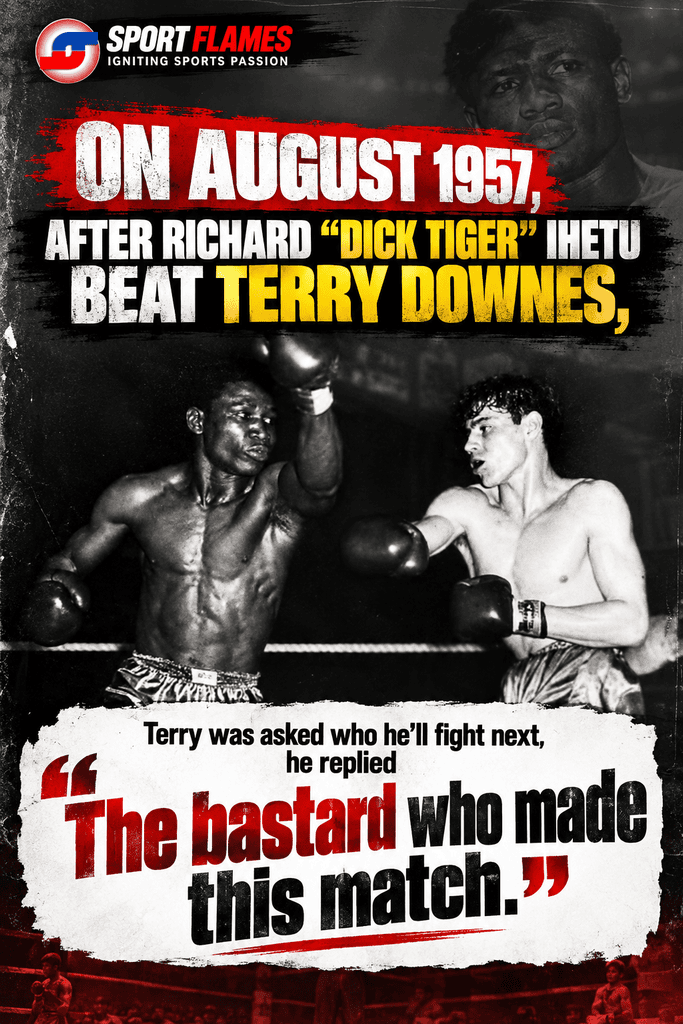
In August 1957, Tiger defeated British boxer Terry Downes. After the fight, Downes was asked who he would fight next.
His answer became part of boxing folklore.
“The bastard who made this match.”
The remark was a reflection of the punishment Downes had endured in the ring against the Nigerian. It also offered an early indication of the reputation Tiger was beginning to build: a powerful, relentless fighter who was anything but an easy opponent.
Tiger’s journey eventually took him to the United States, the centre of professional boxing at the time, where he would establish himself among the sport’s elite.
It was there that the Nigerian began making history.
In 1962, Tiger defeated American boxer Gene Fullmer to become the world middleweight champion. The victory made him the first Nigerian to win a recognised world boxing title and announced his arrival on the international stage.
But Tiger was not satisfied with simply becoming champion.
He successfully defended his middleweight crown before eventually moving up in weight. In 1966, he defeated José Torres to become the world light-heavyweight champion, joining an exclusive group of fighters who had captured world titles in two weight divisions.
For a boxer from Nigeria competing in an era dominated by American and European fighters, Tiger’s achievements were remarkable.
He was known for his aggressive style, physical strength and determination. Inside the ring, he was difficult to intimidate, and his performances earned him the respect of opponents and boxing fans around the world.
Yet Dick Tiger’s story was about more than boxing.

His career unfolded during one of the most turbulent periods in Nigerian history. The Nigerian Civil War broke out in 1967, and Tiger, who was from the southeastern part of the country, found himself caught in the middle of the conflict.
He became a supporter of the Biafran cause and served in a military role during the war. The conflict brought immense personal and national upheaval, and it also marked a difficult chapter in Tiger’s life.
Despite everything happening around him, his legacy as a boxer had already been secured.
Tiger retired from professional boxing in 1970 after a career that included more than 80 professional fights. He finished with 60 victories, including 27 wins by knockout, alongside 19 defeats and three draws.
His accomplishments eventually earned him recognition among boxing’s all-time greats.
In 1991, Dick Tiger was inducted into the International Boxing Hall of Fame, cementing his place among the legendary fighters of the sport.
For Nigerians, however, his importance goes beyond the numbers.
Tiger was competing internationally decades before Nigeria became a regular presence across global sports. He showed that a boxer from Nigeria could travel abroad, defeat established champions and become the best in the world.
He carried the Nigerian name into boxing’s biggest arenas and returned home as a world champion.
Sadly, Tiger’s life was cut short. He died on December 14, 1971, at the age of 42 after battling liver cancer.
More than five decades after his death, however, his name remains part of Nigerian sporting history.
Dick Tiger was not simply a boxer who won world titles. He was a pioneer who opened a door for generations of Nigerian athletes who would follow.
Before the Olympic medals, Premier League stars and world champions that Nigerians celebrate today, there was a fighter from Amaigbo who stepped into the ring against the best in the world and refused to be overwhelmed.
And perhaps Terry Downes’ famous response after their 1957 encounter captured the essence of Dick Tiger better than anything else.
“The bastard who made this match.”
That was the kind of opponent Dick Tiger was.
A Nigerian fighter who conquered the world.