
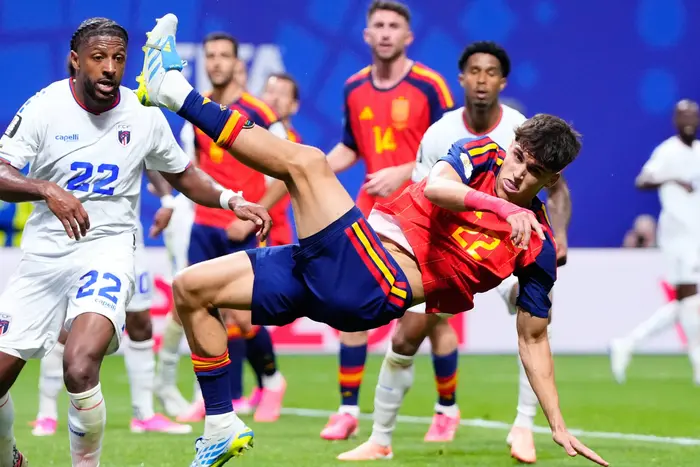
Cape Verde may have stunned the football world with a brave 0-0 draw against Spain at the 2026 FIFA World Cup, but the result still wasn’t enough to rewrite African football history, as Nigeria’s Super Eagles continue to hold a unique and unmatched record against La Roja.
At the Atlanta Stadium, the tournament debutants produced one of the most disciplined defensive performances of the competition so far. Spain fired 27 shots, controlled possession for long spells, and pushed relentlessly for a breakthrough, but Cape Verde held firm to secure a historic point in Group D.
Despite the achievement, the result fell short of matching what Nigeria accomplished nearly three decades ago, the Super Eagles remain the only African team to defeat Spain in regulation time at a FIFA World Cup, that iconic moment came at the 1998 FIFA World Cup in France, where Nigeria produced one of the greatest performances in African football history. After falling behind to goals from Fernando Hierro and Raúl, the Super Eagles mounted a dramatic comeback.
Mutiu Adepoju pulled one back in the 24th minute before an unfortunate Andoni Zubizarreta own goal, forced by Garba Lawal, restored parity. Then came the unforgettable strike Sunday Oliseh’s thunderbolt in the 78th minute that sealed a stunning 3-2 victory for Nigeria in Nantes, it remains one of the defining results of Nigeria’s World Cup legacy and still stands unmatched by any other African nation against Spain in regulation time.
Cape Verde’s draw, while impressive, only adds another chapter to Spain’s generally dominant record against African opposition. The European giants have faced African teams seven times across World Cup history, losing just once in open play to Nigeria in 1998.
Spain’s record against African teams shows consistent control: wins over Algeria (1986), South Africa (2002), Tunisia (2006), and draws with Morocco in 2018 and Cape Verde in 2026. Morocco also famously eliminated Spain in 2022, but that came via penalties after a goalless draw, not in regulation time, that distinction is exactly why Nigeria’s achievement still stands alone.
For Cape Verde, the draw will be remembered as a landmark moment in their football history. But for African football as a whole, it also served as a reminder of how rare and difficult it is to break Spain’s structure on the World Cup stage, meanwhile, Nigeria’s absence from back-to-back tournaments in 2022 and 2026 continues to be felt. The Super Eagles, three-time African champions, will now have to wait until the 2030 FIFA World Cup co-hosted by Spain, Portugal, and Morocco for another chance to test themselves against European football’s elite, until then, one truth remains unchanged: when it comes to beating Spain in regulation time at the World Cup, no African nation has done it better than the Super Eagles.