


Few FIFA World Cup matches live in memory like Ghana vs Uruguay at the 2010 World Cup in South Africa. It wasn’t just a quarter-final. It was a continental moment, a night when Africa stood one kick away from history and heartbreak arrived instead.
At Soccer City in Johannesburg, Ghana weren’t just playing for themselves. They were carrying the hopes of an entire continent still dreaming of its first World Cup semifinalist. The stage was set, the stakes were absolute, and the ending would become one of football’s most painful stories.
The 2010 FIFA World Cup, hosted in South Africa, already carried symbolic weight. It was the first World Cup on African soil, and Ghana had become the continent’s last hope after Cameroon, Nigeria, Ivory Coast, Algeria, and South Africa exited earlier.
Milovan Rajevac’s side had earned their place in the last eight with discipline, energy, and belief. Wins over Serbia and the United States, plus a strong group stage, had built momentum. By the time they faced Uruguay, the Black Stars were no longer underdogs they were a mission.
Uruguay, however, arrived with firepower: Diego Forlán at his peak and Luis Suárez beginning to define his reputation as football’s most instinctive striker. The game itself delivered tension from the first whistle.
Ghana struck just before half-time when Sulley Muntari unleashed a long-range effort that slipped through Fernando Muslera’s hands. It was 1–0, and the stadium erupted in belief.
Uruguay responded through Forlán, whose curling free-kick restored parity early in the second half. From that point, the match became a war of nerves.
Ghana grew stronger as extra time approached. Kevin-Prince Boateng and Dominic Adiyiah both came close, and it felt like destiny was edging toward West Africa.
Then came the final seconds.
With the match heading toward penalties, chaos unfolded in the box. A header from Stephen Appiah and a rebound effort looked destined for goal until Luis Suárez threw himself on the line and used his hands to block the ball.
Red card. Penalty. History in Ghana’s hands. Asamoah Gyan stepped up.
He was the country’s most trusted finisher. He had scored twice from the spot already in the tournament. One strike would send Ghana into the first World Cup semifinal ever reached by an African nation.

The shot was powerful. Clean. But it smashed off the crossbar and out. Silence followed. Then disbelief.
The match went to penalties. Gyan recovered enough to score his kick, but misses from John Mensah and Dominic Adiyiah handed Uruguay a 4–2 shootout win.
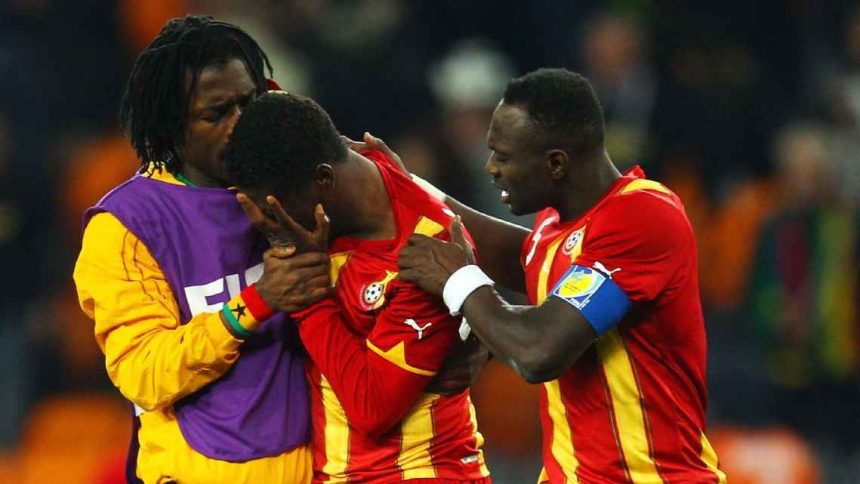
For Ghana, it was more than defeat. It was a moment frozen in time a chance lost at the edge of football immortality.
Suárez, sent off, watched from the tunnel. Uruguay celebrated. Ghana collapsed in heartbreak.
The aftermath lasted far beyond the tournament.
Asamoah Gyan carried the weight of that miss for years, openly admitting the emotional toll. In Ghana, the moment became part of football folklore replayed endlessly, debated constantly, and remembered painfully.
Suárez, meanwhile, never apologised, famously calling his handball a necessary sacrifice for Uruguay.
Over time, even the incident itself has been re-examined in the VAR era, with discussions about a possible offside in the buildup adding new layers to the controversy.
But none of that has softened the emotion.
Football has seen bigger scorelines, bigger finals, and bigger trophies. But Ghana vs Uruguay 2010 remains different because of what it represented. It wasn’t just a match. It was a doorway.
For Ghana, it was the closest Africa has ever come to a World Cup semifinal. For the continent, it was a shared dream paused at the final moment. For football, it became a reminder that greatness is often separated from heartbreak by a single kick.
We don’t just remember the result. We remember the weight of it the hope, the tension, and the silence after the crossbar.
Because some matches don’t end when the whistle blows. They live on every time the ball hits the net… or doesn’t.