

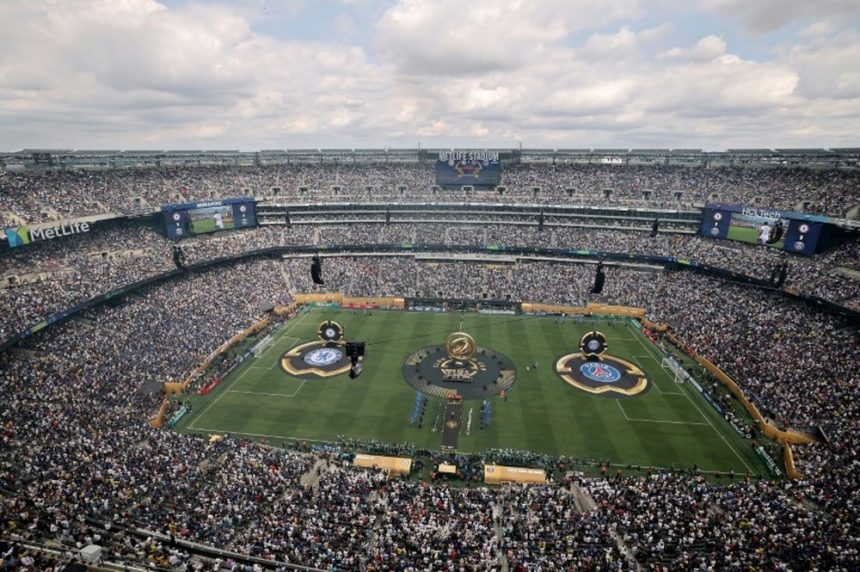


The countdown to the 2026 FIFA World Cup is accelerating, and beyond the star players, fierce rivalries, and tactical battles, another major attraction is already capturing global attention — the stadiums.
For the first time in history, the FIFA World Cup will be hosted across three nations: the United States, Canada, and Mexico. The expanded 48-team tournament will unfold across 16 stunning venues, blending historic football cathedrals with futuristic arenas built for massive sporting spectacles.
At Sport Flame Communications, we take a closer look at the iconic stadiums that will shape the biggest World Cup ever staged.
No stadium carries more World Cup history than Mexico City’s legendary Estadio Azteca.
The iconic arena will officially become the first stadium in football history to host matches at three separate FIFA World Cups after previously staging games in 1970 and 1986. From Pele lifting the trophy with Brazil to Diego Maradona producing football magic for Argentina, the Azteca remains sacred ground in global football.
With a capacity of over 83,000 fans, the stadium will host the opening match of the 2026 World Cup when Mexico face South Africa on June 11.
For many football fans, no venue better represents the spirit of the World Cup.
The tournament’s grand finale will take place at MetLife Stadium in East Rutherford, New Jersey.
Home to both the New York Giants and New York Jets, the massive venue will host eight matches overall, including a semi-final and the World Cup final on July 19.
With a capacity exceeding 82,000 spectators, MetLife Stadium is expected to deliver one of the most electric atmospheres in football history when the next world champion is crowned.
The stadium has already hosted major football events, including the Copa America Centenario final and the FIFA Club World Cup final.
Los Angeles’ SoFi Stadium represents the modern face of sports entertainment.
Widely regarded as one of the most expensive stadiums ever built, the $6 billion arena combines luxury, technology, and breathtaking architecture. Located in Inglewood near Los Angeles International Airport, the venue will host eight World Cup matches, including the United States’ opening fixture against Paraguay.
The futuristic stadium is home to both the Los Angeles Rams and Los Angeles Chargers and is expected to become one of the tournament’s standout venues.
Canada will host matches in Toronto and Vancouver, marking a huge moment for football growth in the country.
BMO Field remains one of the few soccer-specific stadiums among the World Cup venues. Home to Toronto FC, the stadium will host Canada’s opening match against Bosnia-Herzegovina.
The compact design promises a passionate atmosphere, giving supporters a true football experience.

Nestled in the heart of Vancouver, BC Place combines scenic beauty with football heritage. The stadium famously hosted the 2015 FIFA Women’s World Cup final and will stage seven matches during the 2026 tournament, including knockout fixtures.
Its waterfront setting makes it one of the most visually striking stadiums in the competition.
Two of America’s largest and most advanced stadiums are also expected to play central roles during the tournament.
The enormous AT&T Stadium in Arlington, Texas, boasts a capacity of 94,000, making it one of the largest venues in the tournament.
The fully air-conditioned stadium will host nine matches, including a semi-final. Known primarily as the home of the Dallas Cowboys, the arena has also hosted major boxing events, international football matches, and Super Bowls.
Atlanta’s Mercedes-Benz Stadium continues to impress as one of the most technologically advanced stadiums in the world.
Featuring a retractable roof and a massive 360-degree video display, the venue will host eight World Cup games, including a semi-final.
The stadium’s reputation for sustainability and fan experience has made it one of the jewels of modern sports infrastructure.
Several venues traditionally built for NFL franchises will transform into football arenas during the tournament.
Arrowhead Stadium in Kansas City, famous for producing deafening crowd noise, could become one of the most intimidating atmospheres at the World Cup.
Seattle’s Lumen Field already has deep football culture thanks to the Seattle Sounders’ passionate fanbase, while Philadelphia’s Lincoln Financial Field offers a tighter, louder environment ideal for knockout football drama.
Meanwhile, Miami’s Hard Rock Stadium, Houston’s NRG Stadium, Boston’s Gillette Stadium, and San Francisco’s Levi’s Stadium all bring their own unique identity into the tournament.
The 2026 FIFA World Cup is not just expanding in terms of teams it is expanding in scale, spectacle, and global reach.
From historic venues like Estadio Azteca to ultra-modern stadiums like SoFi and Mercedes-Benz Stadium, fans can expect unforgettable football moments played across some of the most impressive sporting arenas on the planet.
The combination of football tradition, North American entertainment culture, and world-class infrastructure promises a tournament unlike anything the sport has ever seen before.
As the road to kickoff continues, the stadiums themselves are already becoming part of the story.
Stay connected with Sport Flame Communications for the latest FIFA World Cup 2026 news, stadium updates, fixture analysis, player stories, and exclusive football coverage from around the world.