
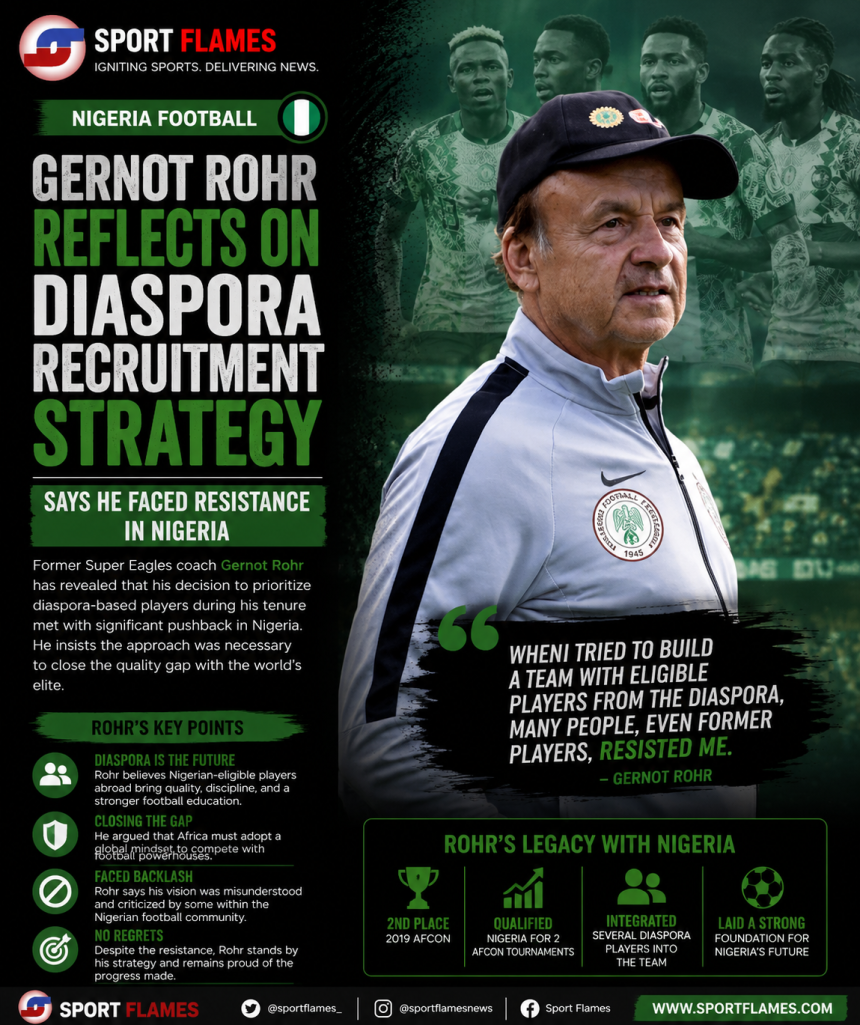


Former Super Eagles head coach Gernot Rohr has revealed that his efforts to recruit Nigerian players born and developed abroad were met with significant resistance during his time in charge of the national team, despite similar strategies now being widely praised following Morocco’s success on the international stage.
Rohr, who managed Nigeria between 2016 and 2021, said he believed attracting eligible diaspora players was one of the most effective ways to narrow the gap between African nations and the world’s footballing elite.
“It Was the Right Approach”
Speaking about his recruitment philosophy, Rohr explained that players developed in Europe often benefit from a different football education, making them valuable additions to African national teams.
I identify it (luring players born abroad) as the way to bridge the gap between teams in Africa and the top teams in the world. The football education is not the same at a certain level, which with all due respect gives the players born abroad an edge,” Rohr said.
According to the German coach, that philosophy was not universally accepted during his time with the Super Eagles.
Morocco’s Success Changes the Conversation
Rohr pointed to Morocco’s recent achievements as evidence that embracing dual-nationality players can significantly strengthen African national teams.
The Atlas Lions’ historic run to the semi-finals of the 2022 FIFA World Cup featured numerous players developed in European academies, a model that has since received widespread praise across African football.
Rohr admitted he found it surprising that the same approach he promoted in Nigeria is now being celebrated.
“During my time in Nigeria I was heavily opposed to doing it. Now it’s what many people are praising Morocco for. The approach is normal as long as the players are eligible nationals‘, he added.
Long-Running Debate in Nigerian Football

The comments have revived a long-standing discussion surrounding the balance between recruiting foreign-born players and developing homegrown talent.
Supporters of the diaspora recruitment strategy argue that dual-nationality players often arrive with experience gained in some of Europe’s most competitive football environments, helping raise the overall standard of the national team.
Others maintain that greater emphasis should be placed on nurturing players within Nigeria’s domestic football structure while ensuring opportunities remain available for local talent.
The debate has remained a recurring topic regardless of who occupies the Super Eagles coaching position.
Rohr’s Legacy
During nearly six years in charge of Nigeria, Rohr guided the Super Eagles to qualification for the 2018 FIFA World Cup and led the team to a third-place finish at the 2019 Africa Cup of Nations.
His squad featured a blend of homegrown players and several foreign-born internationals, including the likes of Alex Iwobi, William Troost-Ekong, Leon Balogun, and Semi Ajayi, all of whom became key figures during his tenure.
Rohr consistently viewed that combination as essential to building a competitive national team capable of challenging Africa’s best.
Debate Set to Continue
As Nigeria continues to build towards future international competitions under its current coaching structure, the discussion surrounding diaspora recruitment is unlikely to disappear.
With more dual-nationality players emerging across Europe’s top leagues every year, striking the right balance between overseas talent and domestic development remains one of the biggest strategic questions facing Nigerian football.
Rohr’s latest remarks have once again brought that conversation into focus, ensuring the debate over the Super Eagles’ recruitment philosophy will continue well beyond the current international cycle.