
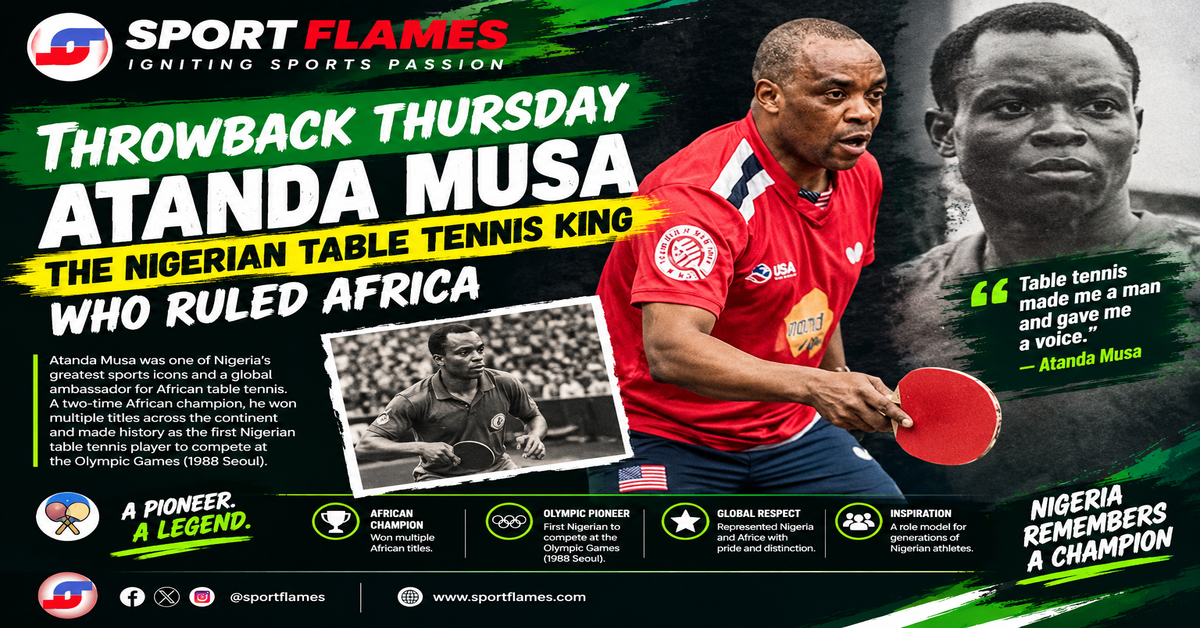
Long before Quadri Aruna became one of Africa’s most recognisable names in world table tennis, and before Segun Toriola built his own remarkable legacy, there was a Nigerian whose name commanded respect across the continent and beyond. His name was Atanda Musa, fondly known as “Mansa Musa”, a player whose speed, skill and competitive fire helped establish Nigeria as a powerhouse in African table tennis.
Born Atanda Ganiyu Musa on February 3, 1960, Musa grew up in Lagos, where his sporting journey did not initially begin with a table tennis racket. As a young boy, he played football, but frequent injuries eventually pushed him towards a different sport. Following his father’s advice, he turned to table tennis at the age of 17. What began as an alternative soon became the foundation of an extraordinary career that would take him from local competitions to the biggest stages in international sport.
His first major breakthrough came at the Western State Sports Festival in 1977. From there, Musa progressed through the junior and senior ranks, steadily building a reputation as one of Nigeria’s most exciting talents. By the early 1980s, he was no longer simply a promising player. He was becoming a force that opponents across Africa and beyond had to reckon with.
Musa’s rise coincided with a golden period for Nigerian table tennis, when the country regularly challenged for honours at continental and Commonwealth competitions. He became one of the leading figures of that generation, combining sharp reflexes with an attacking style that made him difficult to contain. His backhand and trademark loop were among his greatest weapons, allowing him to dictate rallies and put opponents under relentless pressure.

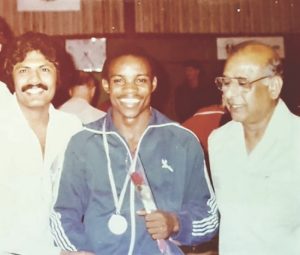
In 1982, Musa announced himself on the international stage by winning the men’s singles title at the Commonwealth Table Tennis Championships in India. He also partnered Sunday Eboh to win the men’s doubles gold medal at the same competition. Three years later, he added another Commonwealth doubles title, partnering Francis Sule at the 1985 championships. These achievements established him as one of Nigeria’s most successful players and demonstrated that his ability extended well beyond African competition.
But it was on the continental stage that Musa’s name became synonymous with dominance. He won multiple African singles titles, with his record reaching an extraordinary ten championships. At the 1987 All-Africa Games in Nairobi, he completed a remarkable clean sweep, winning gold in the men’s singles, men’s doubles and mixed doubles. Four years later, at the 1991 All-Africa Games in Cairo, he repeated the feat, again collecting three gold medals. His achievements made him one of the defining athletes of Nigerian table tennis and a symbol of the country’s authority in the sport.
His success was not limited to Africa. Musa represented Nigeria at the 1988 Seoul Olympics and the 1992 Barcelona Olympics, competing in both singles and doubles. He also made his mark on the international circuit, taking his game to tournaments across Europe and other parts of the world. At the height of his career, he reached No. 20 in the world rankings, an extraordinary milestone for a player from a continent that often struggled for representation at the highest levels of the sport.
Back home, however, some of Musa’s most memorable battles unfolded at the Asoju Oba Cup in Lagos. His rivalry with the late Yomi Bankole became one of the great stories of Nigerian table tennis, drawing passionate crowds and turning their encounters into must-watch sporting occasions. Their contest at the 1984 Asoju Oba Cup final remains especially memorable. Musa won the final and took home a brand-new Peugeot 504, a prize that reflected both his sporting excellence and the importance of the tournament in his rise to prominence.
Behind those victories was also the support of the late Chief Molade Okoya-Thomas, whose backing of the Asoju Oba Cup helped provide a platform for Nigerian players to develop and compete. Musa later acknowledged how important that support had been to his career, describing the tournament as a turning point that helped propel him into the national team and wider public recognition.
As his playing career progressed, Musa began to build a second life in the sport through coaching. In 1992, he moved to Saudi Arabia to work as a full-time coach, spending several years developing players before taking up another coaching role in Qatar in 1995. He returned to Nigeria in 1997, continuing to play, coach and contribute to the development of the game before eventually settling in the United States.
Yet distance from home did not erase his connection to Nigerian table tennis. In later years, Musa turned his attention towards the next generation, supporting youth competitions and creating opportunities for young players to test themselves. His Atanda Musa Invitational Cadet Table Tennis Championships became part of that effort, reflecting his belief that Nigeria still possesses the talent to produce champions if young athletes are given the right encouragement, coaching and competitive opportunities.
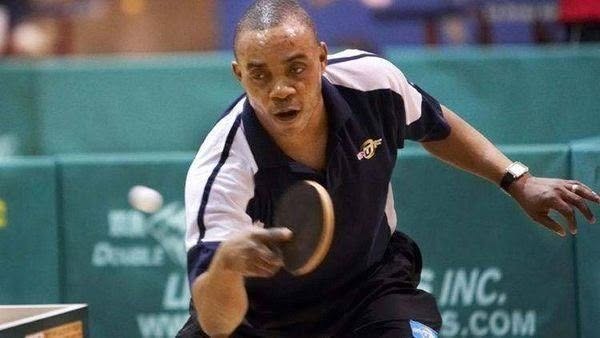
For Musa, the mission was no longer just about winning medals. It was about helping other young Nigerians experience the opportunities that table tennis had given him. His continued involvement has been part of a wider call for stakeholders, sponsors and sports administrators to work together to restore Nigeria’s place among the leading table tennis nations.
Today, Atanda Musa’s legacy stands as a reminder of a period when Nigerian players ruled African tables and competed with confidence against the world’s best. His ten African singles titles, Commonwealth gold medals, Olympic appearances and world ranking tell the story of a champion, but his influence reaches beyond the numbers. He helped inspire a generation, entertained fans with unforgettable rivalries and showed that a Nigerian athlete could rise from local competition to international distinction.
Before the era of Aruna and Toriola, there was Mansa Musa, the Lagos-born champion whose racket helped put Nigeria at the centre of African table tennis. And long after his final competitive rally, his name remains woven into the history of the sport.
Atanda Musa did more than win titles. He helped define an era of Nigerian sporting greatness.