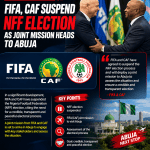

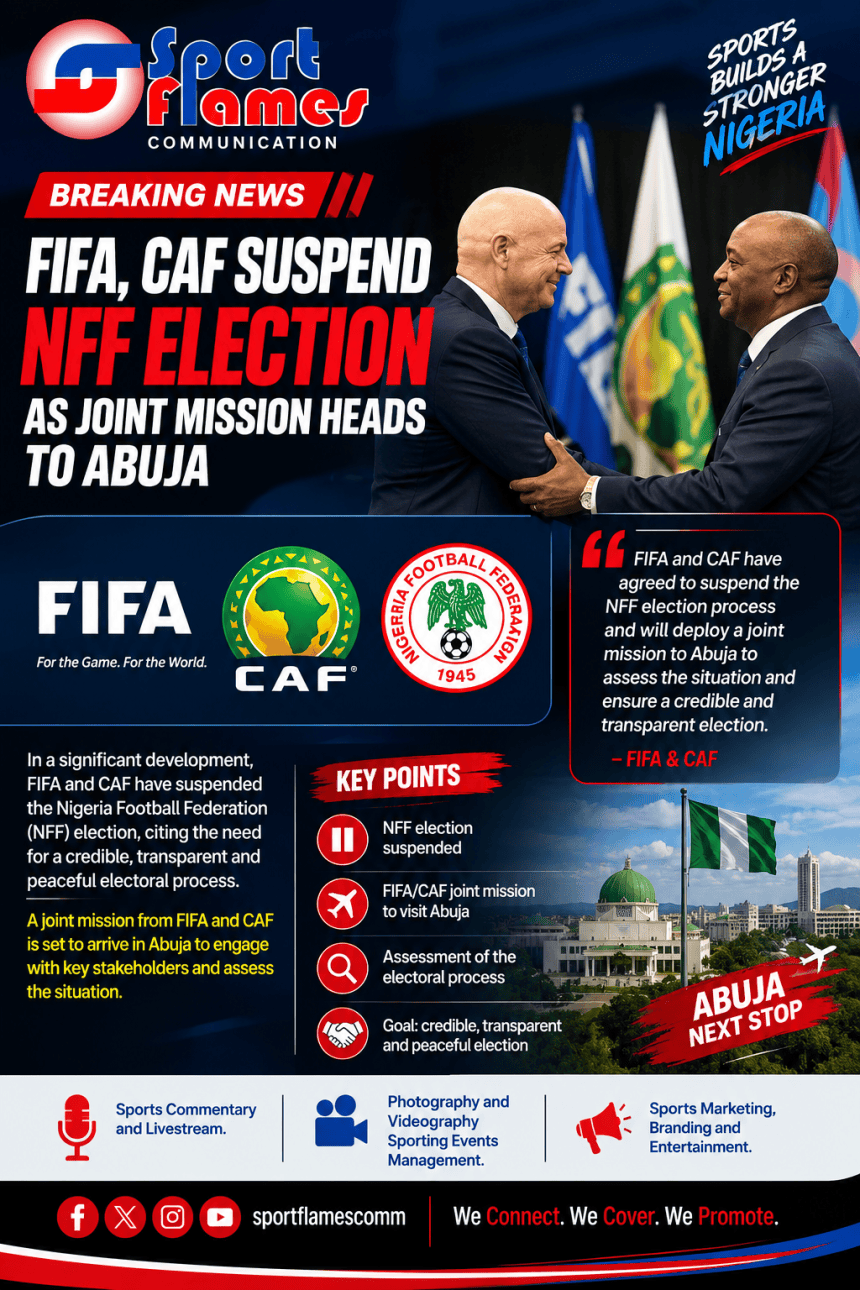


FIFA and the Confederation of African Football (CAF) have suspended the ongoing Nigeria Football Federation (NFF) electoral process and announced plans to send a joint assessment mission to Abuja as the crisis surrounding Nigerian football deepens.
The decision was contained in a letter dated 7 September 2026 and signed by FIFA Chief Member Associations Officer Elkhan Mammadov. The letter was addressed to NFF Acting Deputy General Secretary Emmanuel Ikpeme and copied to CAF.
FIFA and CAF said they are currently examining the legal, governance, administrative and electoral implications of the developments within the NFF.
The latest directive means no further steps should be taken in connection with the NFF electoral process until FIFA and CAF complete their assessment.
The planned NFF elective congress had been scheduled for 27 September in Lafia, Nasarawa State, although the federation had already suspended preparations following the recent leadership crisis.
FIFA and CAF said the suspension was intended to preserve the status quo while they engage relevant stakeholders and review the circumstances surrounding the federation.
Importantly, the two governing bodies stressed that the suspension should not be interpreted as a final decision on the validity of actions or positions taken by any stakeholder.
They also warned that no assumptions should be made about what action FIFA or CAF may eventually take.
FIFA and CAF are now preparing to send a joint assessment mission to Abuja at the earliest possible opportunity.
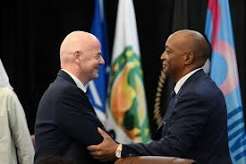
The delegation is expected to meet representatives of the NFF administration, NFF members, the federation’s electoral bodies and the Federal Government, including officials of the National Sports Commission (NSC).
The mission will allow FIFA and CAF to gather information directly from the different parties involved in the crisis before deciding on their next steps.
The organisations said the assessment could eventually lead to recommendations or proposals being submitted to their respective decision-making bodies.
For now, however, FIFA and CAF have made it clear that no final conclusion has been reached.
The FIFA and CAF intervention follows a dramatic collapse in the NFF leadership structure.

NFF President Ibrahim Gusau resigned on 27 August, while General Secretary Mohammed Sanusi and members of the NFF Executive Committee also stepped down.
The resignations created a major leadership vacuum within the federation and forced the NFF to introduce interim administrative arrangements. Emmanuel Ikpeme was appointed to oversee the Secretariat, while other competitions and administrative structures were also affected by the upheaval.
The crisis came after a difficult period for Nigerian football, including the Super Eagles’ failure to qualify for the 2026 FIFA World Cup and the Super Falcons’ failure to qualify for the 2027 Women’s World Cup.
The latest development follows a 1 September meeting in Zurich involving FIFA, CAF, NFF officials and representatives of the Nigerian government.
The meeting was part of efforts to understand the situation within Nigerian football and discuss possible reforms.
President Bola Tinubu had also directed a comprehensive reform of Nigerian football following Gusau’s resignation, with areas such as governance, administration, stakeholder representation, development pathways, domestic competitions and accountability identified for attention.
However, reports that a final agreement had already been reached on the proposed reforms have been contradicted by FIFA’s latest communication.
FIFA and CAF said their assessment is still ongoing and that no final determination has been made.
FIFA has also identified Emmanuel Ikpeme as its primary point of contact with the NFF during the assessment process.
According to Vanguard, FIFA currently recognises Ikpeme as Deputy General Secretary rather than Acting General Secretary and wants communication between the NFF, FIFA and CAF to go through him until further notice.
This places the NFF Secretariat at the centre of the international body’s engagement with Nigerian football stakeholders as the assessment continues.
The immediate future of the NFF election is now uncertain, FIFA and CAF will first complete their assessment and engage stakeholders in Abuja before deciding whether recommendations should be presented to their respective decision-making bodies.
That means possibilities being discussed publicly should not yet be treated as confirmed outcomes. FIFA and CAF have specifically stated that the final outcome remains open.
For Nigerian football, the development represents another major twist in a leadership crisis that has already forced the postponement of the federation’s electoral activities.
With the September 27 election now firmly on hold, attention will turn to the FIFA-CAF mission and whether its findings can provide a clear path towards resolving the NFF’s leadership and governance crisis.