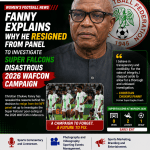




Former Nigeria Football Federation General Secretary Fanny Amun has explained why he resigned as chairman of the NFF fact-finding committee investigating the Super Falcons’ disappointing 2026 Women’s Africa Cup of Nations campaign.
Amun said he stepped down immediately after submitting the committee’s report because he wanted to protect the integrity and independence of its findings.
The veteran football administrator made the revelation at a press conference in Lagos, insisting that he did not want anyone to influence or alter the committee’s conclusions after the investigation had been completed.
According to Amun, his decision to resign was deliberate.
He explained that although the committee was given two weeks to complete its assignment, he knew the investigation would not require that much time.
Amun said he deliberately told the committee members that the work would take two weeks because he wanted to complete the investigation and submit the report before anyone could attempt to influence its findings.
“I did not want anyone to influence the report before I submitted it to the NFF. That was why I submitted it and resigned,” Amun said.
He confirmed that his resignation became effective immediately after the report was handed over.
For Amun, the priority was not remaining in the position but ensuring that the committee completed its responsibility without interference.
The NFF inaugurated the fact-finding committee on August 17 following a difficult period for Nigeria’s national teams.
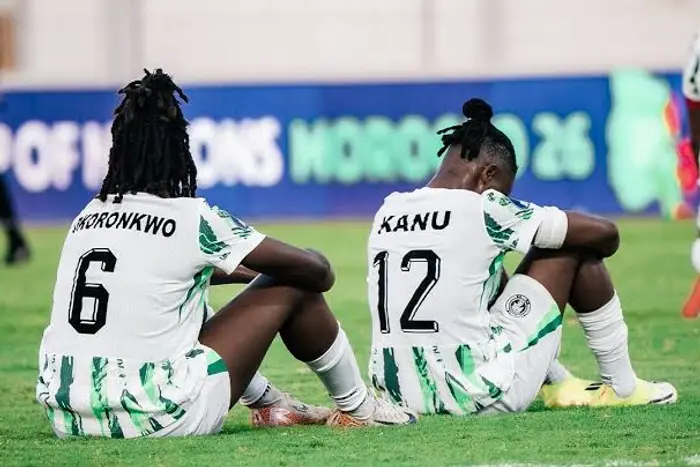
The immediate concern was the Super Falcons’ disastrous 2026 WAFCON campaign.
Nigeria entered the tournament as defending champions and 10-time winners but suffered a quarter-final defeat to Cameroon.
The setback was followed by another major blow when the Super Falcons lost 2-1 to South Africa in the play-off for a place at the 2027 FIFA Women’s World Cup.
The defeat ended Nigeria’s record of appearing at every edition of the Women’s World Cup since the competition began in 1991.
Although the Super Falcons’ WAFCON failure was the immediate trigger, the committee’s mandate was broader.
NFF President Ibrahim Musa Gusau tasked the panel with investigating the direct and remote causes of Nigeria’s recent poor performances across international competitions.
The committee was also expected to engage relevant stakeholders, receive submissions and develop recommendations capable of addressing the wider problems affecting Nigerian football.
That meant the investigation went beyond the Super Falcons’ results.
It examined issues surrounding administration, technical development, player welfare, coaching, grassroots football and the overall structure of the game.
Amun chaired a six-member panel made up of experienced figures from Nigerian football.
The members included former Nigeria U-20 coach Ladan Bosso, former Super Falcons star Desire Oparanozie, former Super Eagles midfielder Mutiu Adepoju and former FIFA referee Alex Mana.
Nasiru Jibril served as the committee’s secretary.
The combination of former administrators, coaches, players and football officials was intended to provide different perspectives on the challenges facing Nigeria’s national teams.
Amun’s departure was not limited to the fact-finding committee, he also announced his resignation from the NFF Ethics Committee.
He thanked NFF President Ibrahim Gusau, the federation’s General Secretary and other members of the board for giving him the opportunity to serve.
However, he maintained that his assignment on the fact-finding committee had been completed after the report was submitted.
Amun also said he remained available should further clarification be required.

The contents of the report have not yet been formally released by the NFF.
However, reports emerging from the investigation indicate that the committee identified broader administrative, technical, financial, organisational and developmental problems within Nigerian football.
The report reportedly concluded that the Super Falcons’ struggles were part of wider structural challenges rather than an isolated failure.
One issue reportedly examined was the suggestion that certain players had undue influence over selection.
The committee found no evidence establishing that individual players influenced the selection process, according to reports on the findings.
The panel nevertheless recommended clearer responsibilities within the technical department and a more deliberate approach to player development and team management.
During his press conference, Amun also raised concerns about the NFF’s electoral statutes.
He questioned provisions that he said exempt serving board members from the same anti-corruption screening required of other candidates.
Amun argued that all candidates, including sitting board members, should face appropriate ethical and financial scrutiny.
He also called for elected football administrators to be restricted to a maximum of two terms.
The comments broadened the discussion from the Super Falcons’ performance to the governance of Nigerian football itself.
Amun also raised concerns about the welfare of players, coaches and federation employees.
He alleged that board members received full allowances during foreign trips while players and coaches were sometimes left with less.
He further raised concerns about long-serving federation employees who, according to his account, remained on temporary contracts despite spending decades working within the system.
These claims form part of Amun’s broader argument that Nigerian football needs structural reforms rather than short-term responses whenever a national team fails.
The Super Falcons’ WAFCON disappointment has already led to major changes.
The NFF relieved Justin Madugu and his technical crew of their duties following the team’s failure to defend their continental title and qualify for the 2027 Women’s World Cup.
However, Amun’s committee suggests that changing the coach alone may not solve the underlying problems.
If administrative, developmental and organisational weaknesses remain, another coaching change could simply produce another temporary solution.
The bigger challenge is building a system that consistently produces well-prepared national teams.
With Amun’s report submitted, attention will now shift to the NFF.
The federation must decide what to do with the committee’s recommendations and whether the findings will lead to meaningful changes.
The NFF has not yet publicly released the full report.
That means Nigerian football stakeholders and supporters will be watching closely to see which recommendations are accepted and, more importantly, which ones are implemented.
For Amun, the job is finished, he has submitted the report and stepped away from the committee.
Now the responsibility lies with the federation to determine whether the investigation becomes another document on the shelf or the starting point for serious reform.
The Super Falcons’ WAFCON failure exposed a major problem, what happens next will determine whether Nigerian football learns from it.