
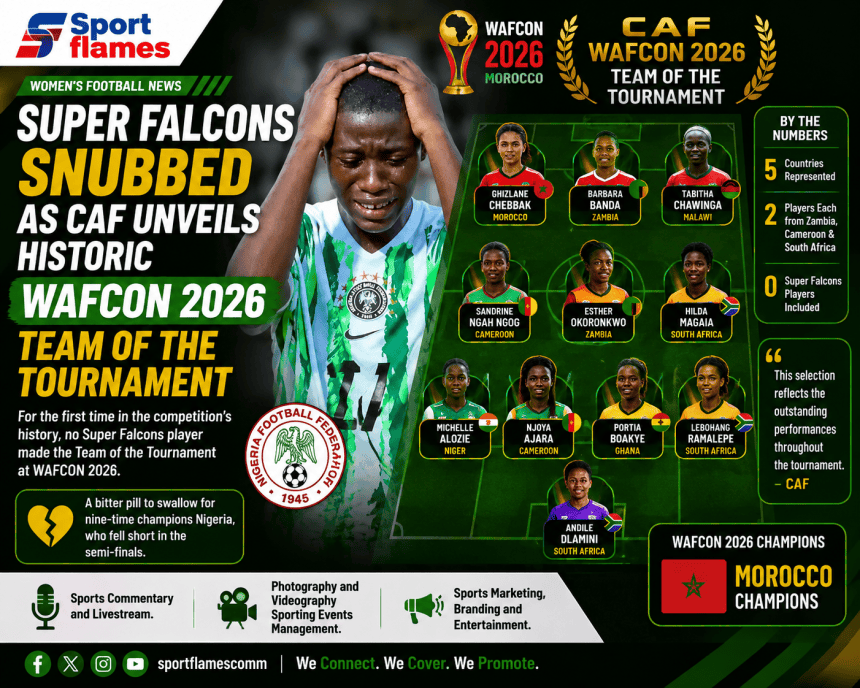


Nigeria’s Super Falcons have suffered another unwanted setback after CAF unveiled the official 2026 Women’s Africa Cup of Nations Team of the Tournament without a single Nigerian player.
The omission is particularly significant because the Super Falcons had previously been represented in every WAFCON Team of the Tournament.
For the 10-time African champions, the development adds another disappointing chapter to a campaign that ended with Nigeria failing to reach the semi-finals and subsequently missing out on automatic qualification for the 2027 FIFA Women’s World Cup
The CAF-selected Best XI reflects the teams that made the biggest impact during the tournament.
Cameroon, who eventually lifted the WAFCON trophy, have four representatives in the team, including goalkeeper Michaely Bihina and defender Myriam Nyadjou.
Malawi, who produced one of the surprise stories of the competition, also have two players in the XI.
Temwa Chawinga and her sister Tabitha Chawinga were both rewarded for their outstanding performances during Malawi’s historic campaign.
Algeria and Morocco also have two players each, while Zambia’s Barbra Banda completes the attacking line.
The official selection features:
Goalkeeper: Michaely Bihina – Cameroon
Defenders: Ines Belloumou – Algeria, Nohaila Benzina – Morocco, Myriam Nyadjou – Cameroon, Hanane Aït El Haj – Morocco
Midfielders: Monique Ngock – Cameroon, Temwa Chawinga – Malawi, Marine Dafeur – Algeria
Forwards: Tabitha Chawinga – Malawi, Marie Ngah – Cameroon, Barbra Banda – Zambia
Coach: Valentine Nguele – Cameroon
The selection demonstrates just how strongly Cameroon influenced the tournament, with four players and the head coach included after their championship-winning campaign, the biggest talking point from the announcement is Nigeria’s complete absence.
The Super Falcons have traditionally been one of the dominant forces in African women’s football, winning the WAFCON title 10 times.
Their failure to produce a single player for the tournament’s Best XI therefore represents a major statistical and symbolic setback.
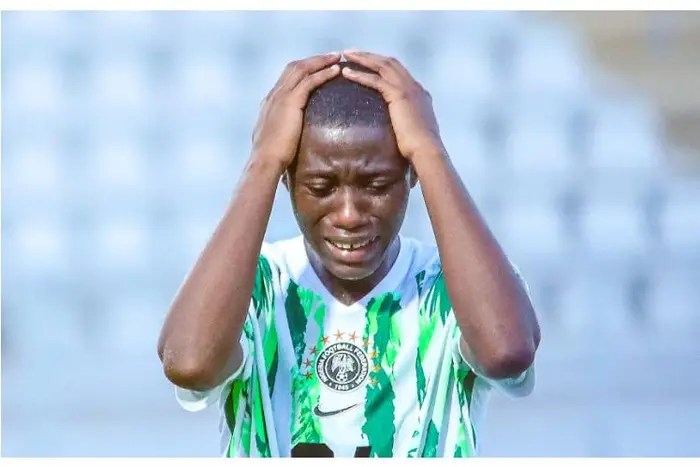
Nigeria’s campaign ended in the quarter-finals after a 1-0 defeat to Cameroon.
The loss ended the team’s hopes of defending the African title and prevented the Super Falcons from securing one of the automatic qualification places for the 2027 FIFA Women’s World Cup.
Nigeria entered WAFCON 2026 with high expectations after winning the previous edition.
However, the tournament did not go according to plan, the Super Falcons suffered a shock defeat to Malawi in their opening group match before recovering against Zambia.
They then produced an impressive 6-2 victory over Egypt to qualify for the knockout stage.
But the quarter-final against Cameroon exposed Nigeria’s struggles in front of goal and ultimately ended their title defence.
Cameroon went on to win the competition, making Nigeria’s quarter-final defeat even more painful for the defending champions.
The WAFCON disappointment also had consequences beyond the continental tournament.
Because Nigeria failed to reach the semi-finals, the Super Falcons missed out on direct qualification for the 2027 FIFA Women’s World Cup.

Nigeria had appeared at every edition of the Women’s World Cup since the tournament began in 1991.
That remarkable record was subsequently placed under serious threat after the team failed to progress through the additional qualification route.
The Super Falcons eventually missed out on the World Cup, bringing an end to Nigeria’s record of appearing at every edition of the competition.
Being selected for a WAFCON Team of the Tournament is one of the strongest individual recognitions an African player can receive at continental level.
The selection is a reflection of consistent performances throughout the competition rather than one standout match.
For the players selected, it provides recognition for their contribution to their respective countries’ campaigns.
For Nigeria, however, the absence of any Super Falcons player will inevitably lead to questions about the team’s overall performance.
Players such as Rasheedat Ajibade, Chiamaka Nnadozie, Asisat Oshoala and other senior members of the squad were unable to make the final selection.
Cameroon’s dominance of the Best XI is unsurprising after the Indomitable Lionesses produced a tournament-winning campaign.
The team eliminated Nigeria before continuing their run towards the title, goalkeeper Michaely Bihina was recognised for her performances, while Myriam Nyadjou earned a place in defence.
Monique Ngock also made the midfield, while Marie Ngah was selected among the forwards, Cameroon coach Valentine Nguele completed the recognition by being named coach of the tournament.
The awards provide further evidence of Cameroon’s influence on WAFCON 2026, the inclusion of Temwa and Tabitha Chawinga is another major highlight.
Malawi entered the tournament as debutants but quickly became one of the competition’s most exciting teams.
Temwa was one of the tournament’s leading attacking players, while Tabitha also made a significant contribution.
Their inclusion in the Best XI confirms the impact Malawi had on WAFCON 2026.
The Scorchers’ unexpected run deep into the competition was one of the tournament’s defining stories.
The CAF announcement comes after significant changes within the Super Falcons setup.
Following Nigeria’s disappointing WAFCON campaign, the Nigeria Football Federation ordered the technical crew to step down with immediate effect.
The decision brought an end to Justin Madugu’s tenure as head coach, the next coaching appointment will therefore be crucial.
Nigeria needs to rebuild the team, identify emerging talent and restore the confidence that has made the Super Falcons Africa’s most successful women’s national team.
The absence from the CAF Best XI should serve as another reminder that the team cannot rely solely on its history.
Nigeria’s exclusion from the WAFCON Team of the Tournament does not erase the achievements of the players or the country’s remarkable history in African women’s football.
However, it does underline how far the team fell short of expectations in Morocco.
The Super Falcons have traditionally set the standard on the continent.
This time, Cameroon, Malawi, Algeria, Morocco and Zambia produced players who earned greater recognition from CAF.
For Nigerian football, the response will be more important than the disappointment itself, the rebuilding process has already begun.
The challenge now is to ensure that the Super Falcons return to the top of African women’s football and that the next CAF Team of the Tournament once again has Nigerian names on it.