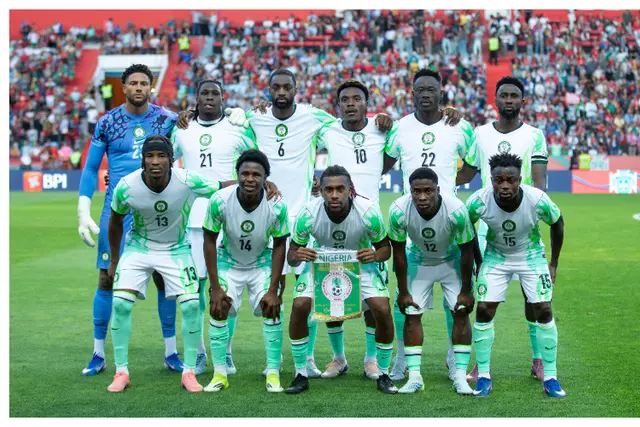
Nigeria’s failure to qualify for the 2026 FIFA World Cup remains one of the biggest disappointments in the country’s recent football history. With Africa receiving a record ten qualification slots for the tournament in the United States, Canada and Mexico, many expected the Super Eagles to secure a place among the continent’s representatives.
Instead, the three-time African champions will once again watch football’s biggest event from home, former Super Eagles defender Chikelue Iloenyosi believes there is one group that must shoulder the blame the players themselves.
Iloenyosi Points Fingers at Super Eagles Stars
Speaking on Nigeria’s painful World Cup absence, the former international dismissed suggestions that coaching instability was the main reason behind the failed qualification campaign. Nigeria’s journey to the 2026 FIFA World Cup saw the team work under three different managers, creating inconsistency and uncertainty during the qualifying series. However, Iloenyosi insists the players had enough quality to overcome those challenges.
“Why we did not qualify for the World Cup is the players. It’s the fault of the players because you can see the games, they are even blaming themselves. They are not happy,” he said.
His comments reflect the frustration shared by millions of Nigerian supporters who expected a squad filled with top players competing across Europe’s elite leagues to deliver qualification, for a team boasting talents such as Victor Osimhen, Ademola Lookman, Alex Iwobi, Wilfred Ndidi and Samuel Chukwueze, missing out on an expanded 48-team World Cup remains difficult to accept.
The Pain Goes Beyond Missing a Tournament
According to Iloenyosi, the disappointment inside the squad is genuine, the former defender believes the players understand exactly what has been lost.
“How can I be happy? Players are feeling very, very bad, of course. If they have a chance to be in the World Cup, they will be in the World Cup to prove themselves.”
For many footballers, the FIFA World Cup represents the highest stage of the sport. It is where careers are elevated, legacies are built and unforgettable moments are created. Iloenyosi also pointed out a painful reality for some members of the current squad.
“Some people in the national team might not see the World Cup again because of their age.”
That statement perhaps captures the magnitude of Nigeria’s failure better than anything else, the next World Cup comes in 2030. By then, several experienced players may have retired from international football or moved beyond their peak years, opportunities to play at the World Cup are rare. Missing one often means missing it forever.
Signs of Progress Under Eric Chelle
Despite his criticism of the players, Iloenyosi acknowledged that there are reasons for optimism, the former defender believes the Super Eagles are beginning to show signs of improvement under head coach Eric Chelle.
“I’m not happy we did not qualify… we’ve gotten a coach that came to stabilise the team. If you see the standard of the games we are playing now, you can know the coach wants the team to improve.”
Recent performances have indeed offered encouragement, the Super Eagles have displayed greater organisation, intensity and tactical discipline in their latest outings. While the pain of missing the World Cup cannot be erased, the team appears to be rebuilding with clearer direction, that progress will now be tested in the upcoming 2027 Africa Cup of Nations qualifiers.
With the World Cup dream gone, Nigeria’s immediate attention turns to the 2027 Africa Cup of Nations qualifying campaign, the Super Eagles have been drawn in Group L alongside Guinea-Bissau, Madagascar and Tanzania, on paper, Nigeria possess enough quality to navigate the group successfully. However, recent experiences have taught fans that reputation alone guarantees nothing, the challenge for Eric Chelle will be ensuring the lessons from the World Cup qualification disappointment are not wasted.
The players must transform frustration into motivation, blame for Nigeria’s World Cup failure will continue to spark debate, some supporters will point to administrative issues, others will highlight coaching changes, while many will question tactical decisions made during crucial qualifiers, but Chikelue Iloenyosi’s argument cannot be dismissed entirely.
Ultimately, football matches are won and lost on the pitch. The Super Eagles had opportunities to secure qualification and failed to capitalise on them, the painful truth is that some members of this talented generation may never experience the FIFA World Cup as players.
Yet football always offers another chance at redemption, for the Super Eagles, that opportunity begins with the 2027 AFCON qualifiers, the road to recovery starts now, and the responsibility lies with the same players who, according to Iloenyosi, are already blaming themselves. Sometimes the hardest lessons in football become the foundation for future success.