
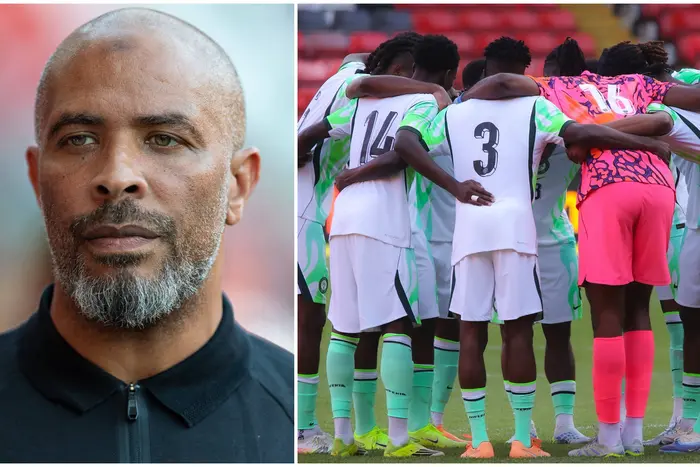


Super Eagles head coach Eric Chelle has finally opened up on the thinking behind his bold squad rotation strategy during Nigeria’s Unity Cup campaign in London, insisting that the experiment is part of a long-term plan aimed at building a stronger, more resilient national team ahead of the Africa Cup of Nations (AFCON).
Nigeria’s 2–0 victory over Zimbabwe at The Valley in Charlton capped off a tournament that saw Chelle heavily rotate his squad, fielding a mix of debutants, fringe players, and emerging talents while leaving out some established stars. For many fans, it looked like experimentation. For Chelle, it was calculated preparation.
The Super Eagles coach explained that the decision to rotate his squad was driven by the need to solve one of Nigeria’s most persistent tournament problems: fatigue and lack of squad depth during the knockout stages of major competitions.
According to Chelle, Nigeria’s past struggles in tournaments have often been linked to over-reliance on a fixed starting eleven, which becomes physically and mentally exhausted when the competition reaches its decisive stages.
His solution is to build what he described as a reliable “Plan B” system a second wave of players capable of maintaining intensity and quality when starters drop off due to fatigue or tactical changes. Chelle’s approach is not just about giving opportunities. It is about building trust across the entire squad.
The London Unity Cup provided the perfect testing ground for Chelle’s philosophy. By rotating heavily and introducing new faces into high-pressure international matches, the coach aimed to assess how different players respond under competitive conditions.
Players such as Millwall forward Femi Azeez made immediate headlines after scoring on his debut, while other fresh call-ups also impressed with energetic performances that added unpredictability and intensity to the team’s play.
Chelle explained that exposing new players to international football early is essential for building a squad capable of handling the demands of tournament football. In his view, depth is not just about numbers it is about readiness.
One of Chelle’s central concerns is the physical toll of tournament football, particularly at AFCON level, where matches are often tightly scheduled and intensely physical.
Nigeria’s historical challenge has been maintaining performance levels deep into competitions. While the Super Eagles often start strongly, fatigue and limited squad rotation options have previously contributed to late-stage exits.

Chelle is determined to change that pattern by ensuring that every position on the pitch has multiple capable replacements who can step in without disrupting the team’s rhythm or identity. This means that players who traditionally sit on the fringes are now being integrated into the core tactical system rather than being treated as backups.
The experimental squad in London also reflects a broader shift in identity under Chelle’s leadership. The Super Eagles are increasingly being shaped into a fluid, adaptable team that relies on tactical flexibility rather than fixed personnel.
The inclusion of emerging talents alongside established internationals signals a transition phase where competition for places is being deliberately intensified. Chelle believes that this internal competition will raise performance levels across the board and ensure that no player feels guaranteed a starting position.
Beyond tactics, Chelle’s strategy is also psychological. By building a squad where multiple players can influence outcomes, Nigeria becomes less predictable to opponents.
Opposing teams can no longer rely on targeting a small group of key players, as the Super Eagles now possess attacking, midfield, and defensive options capable of changing games from the bench.
This depth-focused model is designed to give Nigeria an edge in tight knockout fixtures, where games are often decided by late substitutions and tactical adjustments. The Unity Cup campaign in London has now been positioned as a foundational phase in Chelle’s broader AFCON preparation plan.
The final test comes against Jamaica in the tournament final, but the bigger objective goes far beyond silverware. It is about confirming that Nigeria now has the squad structure required to compete consistently at the highest level.
If Chelle’s vision continues to take shape, the Super Eagles could enter AFCON not just with a strong starting eleven, but with one of the deepest and most competitive squads on the continent.
For now, the message from the coach is clear: Nigeria is no longer building a team of eleven players, they are building a system of twenty-three ready-made solutions.