

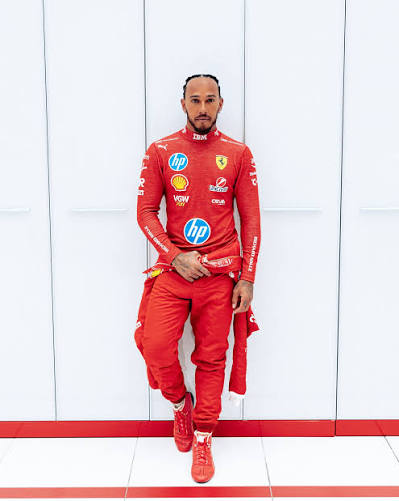


As the 2026 Formula 1 season ignites in Melbourne, Ferrari’s Lewis Hamilton has shifted focus from the asphalt to a deeply personal cause. In a candid pre-race press conference, the 41-year-old seven-time champion revealed his West African heritage, identifying roots in Benin, Senegal, and Nigeria.
This revelation serves as more than a personal reflection; it acts as the cornerstone of his long-standing, impassioned campaign to bring the pinnacle of motorsport back to the African continent.
A Call for Sovereignty
Hamilton’s remarks moved quickly from the personal to the political. Addressing the long history of external influence on the continent, the British icon challenged the status quo with uncharacteristic bluntness:
“It’s the most beautiful part of the world, and I don’t like that the rest of the world owns so much of it and takes so much from it and no one speaks about it.”
Hamilton is calling for a paradigm shift, urging leaders to unite and reclaim their resources. He views the absence of an African Grand Prix as a continuation of this cycle of taking, arguing that if F1 is truly a global sport, it can no longer afford to ignore the continent.

The Road Ahead
While the dream of an African Grand Prix remains elusive, Hamilton’s vision is gaining traction. His advocacy is multifaceted:
The Goal: Establishing a permanent home for F1 in Africa, with high-profile discussions regarding Rwanda and the historic Kyalami circuit in South Africa.
The Stance: Hamilton has explicitly criticized the sport’s expansion into other territories while leaving Africa, which he describes as possessing the resources to be the “most powerful place in the world,” sidelined.
The Ferrari Era: Now driving for Ferrari, Hamilton continues to use his elevated platform to push for infrastructure improvements and diplomatic engagement, emphasizing that his commitment to an African GP is not just a passing interest, but a central tenet of his late-career legacy.
As the season progresses, Hamilton’s campaign serves as a poignant reminder that for the seven-time champion, the most important race may not be the one on Sunday—it’s the one to reshape the sport’s footprint on the world stage.