
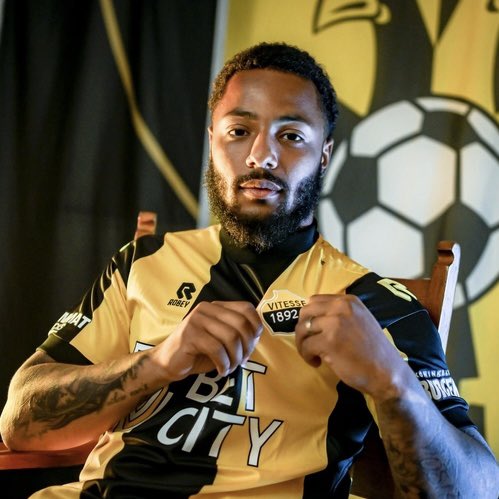


Dillon Hoogewerf’s journey through European football has taken him from elite academies in the Netherlands and England to the professional grind of the Dutch second tier. Now, the 23-year-old winger believes the next chapter of his story should be written in green and white.
Dillon Hoogewerf has publicly declared his desire to represent the Nigeria national football team instead of the Netherlands, reigniting conversations about Nigeria’s growing success in recruiting dual-national talents across Europe.
Born in Almere in 2003 to a Nigerian mother, Hoogewerf’s connection to the country has always been personal rather than symbolic. He has visited Nigeria several times and speaks about it not as an abstract option, but as home in a deeper sense.
“It’s my mother’s country,” he explained in an interview with Voetbal International. “That culture suits me better.”
Those words carry weight for a player whose football education was shaped entirely in Europe. Hoogewerf began at Almere City before earning a move to the famed academy of Ajax, where his technical sharpness and attacking instinct marked him out as a promising talent. That promise secured a high-profile switch to Manchester United’s youth system, a move that placed him among some of the continent’s most highly rated prospects.
Though he did not break into United’s senior side, the experience sharpened his professionalism. A subsequent spell with Borussia Mönchengladbach II offered further tactical grounding before he sought regular first-team football.
That opportunity arrived at SBV Vitesse. Since joining the Arnhem-based club in 2024, Hoogewerf has rediscovered momentum. Wearing the No. 7 shirt, he has emerged as one of the brighter attacking sparks in the Eerste Divisie this season, contributing nine goals and around ten total goal involvements across competitions. Quick over short distances, technically clean in tight spaces, and comfortable drifting inside from the left, he has quietly rebuilt his trajectory.

His international path, however, has been less straightforward.
Hoogewerf represented the Netherlands at the youth level, featuring for the U15, U16, and U17 sides, and once appeared destined to continue along that track. But at 16, an approach from Nigeria altered the outlook. Then the pandemic struck. Travel restrictions and disrupted schedules stalled discussions, and momentum faded.
“This season, we reconnected,” he revealed. “To represent Nigeria, I need to perform at a better level.”
That realism reflects a player aware that international football is earned, not granted. Under head coach Eric Chelle, competition for attacking roles in the Super Eagles setup remains fierce. Yet Nigeria has shown consistent willingness to integrate diaspora players who demonstrate both form and commitment, a pathway successfully navigated by figures such as William Troost-Ekong.
For Hoogewerf, the motivation extends beyond opportunity. He speaks about legacy, about being remembered, and about representing something bigger than himself. In an era when dual eligibility often becomes a strategic calculation, his tone suggests something more emotional: a desire for belonging.
Whether he ultimately earns a senior call-up will depend on sustained performance and continued dialogue with Nigerian officials. A move to a top-flight league could accelerate that process. For now, he controls what he can: form, focus, and consistency.
The message, however, is unmistakable. If the call comes, Hoogewerf already knows his answer.