
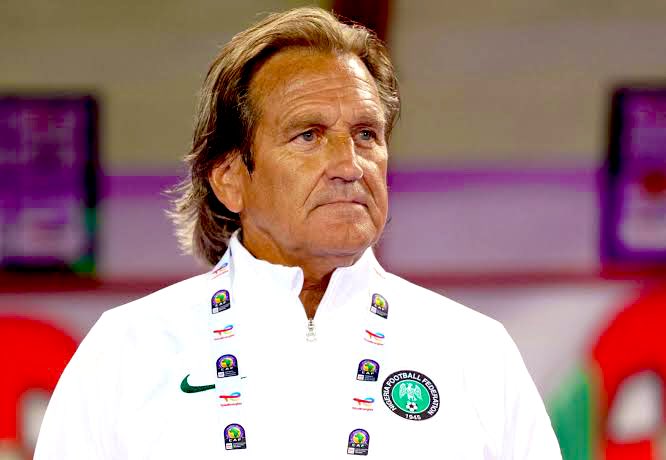


Former Super Falcons head coach Randy Waldrum has delivered his most explosive and detailed account of his time in charge of Nigeria’s women’s national team, revealing a tenure defined by passion, administrative dysfunction, communication failures, and long periods without pay.
In an in-depth interview with EaglesTracker, the 67-year-old American opened up about the highs and lows of his four years with the Super Falcons, touching on his excitement for the project, his failed 2017 appointment, the controversy around his dual roles, and the financial instability that forced him to keep two jobs.
“I Was So Excited” — Why Waldrum Took the Nigeria Job
Waldrum described coaching Nigeria as one of the most exciting prospects of his career, saying the country had the talent to dominate world football if only the structures were right.
“When the opportunity came, I was so excited. Nigeria has so much potential.
I thought I could bring new ideas and long-term planning.”
He revealed that he created a 10-year development plan aimed at making Nigeria a world champion, insisting that while the country always had elite players, it lacked organization.
Despite the internal challenges, Waldrum insists he loved his four years in Nigeria:
“We had a lot of success. I loved my time with the Super Falcons.”
Why He Turned Down the Job in 2017
Waldrum offered clarity on the confusion surrounding his failed first appointment.
In 2017, after initial contact from the NFF through U.S. Soccer, he was flooded with congratulatory messages—despite never having spoken to anyone from the federation.
“I saw on social media that I was the new coach, but I had never spoken to anyone.
For months I tried to reach the NFF for confirmation or contract details but got no response.”
With no communication from Nigeria, he accepted an offer from the University of Pittsburgh. Only afterward did he finally reach NFF president Amaju Pinnick—who insisted the job was still his.
But by then, it was too late.

This chaotic ordeal was why Waldrum later accepted the second appointment only on the condition that he could remain at Pittsburgh.
“There Were Times I Was Not Paid for 14 Months” — Why He Kept Two Jobs
Waldrum’s decision to manage both the Super Falcons and the University of Pittsburgh sparked controversy in Nigeria, but the coach says survival, not preference, motivated the arrangement.
He described major financial insecurity during his time with the NFF.
“I heard coaches don’t get paid on time, and here in the USA, if you miss payments, you lose your home.”
His fears became reality:
“There were times I was not paid for 14 months. I would have lost my home and car.”
Waldrum stressed he would have left Pittsburgh if Nigeria had provided stable pay and professional structure.
“I was willing to step down from Pittsburgh if everything worked the right way.”
He added that the dual-job setup may have actually benefited the NFF during the COVID era, as they avoided paying him a full-time national team salary.
Success on the Pitch Amid Chaos Behind the Scenes
Despite the administrative turbulence, Waldrum’s tenure is widely regarded as a turning point for the Super Falcons.
Notable achievements under Waldrum:
- Reached the Round of 16 at the 2023 FIFA Women’s World Cup, unbeaten in open play
- Restored tactical structure, discipline, and competitiveness
- Qualified Nigeria for the 2024 Olympics (first since 2008)
- Managed generational transition while remaining competitive
Waldrum’s revelations, however, once again spotlight the longstanding issues in Nigerian football: late salaries, poor communication, weak planning, and fragile support structures.
A Tenure Defined by Passion and Frustration
Randy Waldrum leaves a complex legacy: a coach who brought the Super Falcons back to global relevance but who also endured some of the most difficult working conditions in modern international football.
His candid interview paints a picture of a system still struggling to fully support its elite teams and a coach who persevered despite it all.